
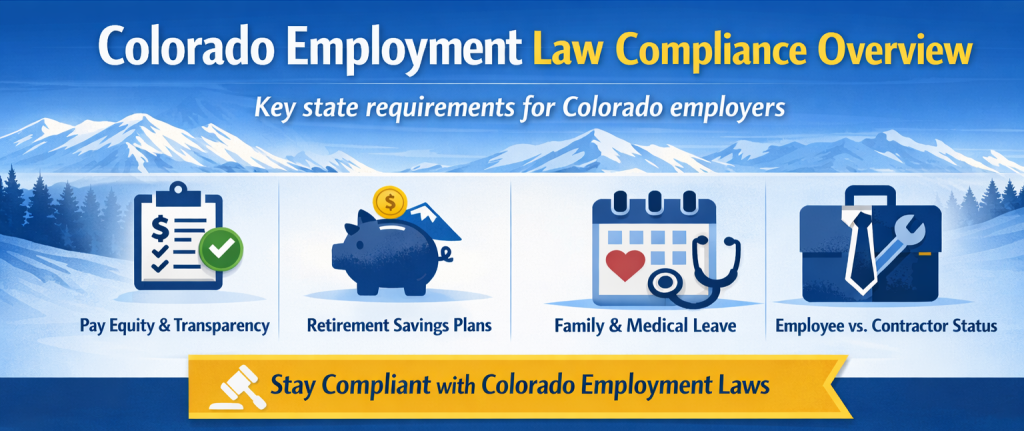
Colorado Employer Compliance Essentials
Review the major state mandates affecting Colorado employers — and make sure your practice is prepared!
Colorado Secure Savings
Colorado SecureSavings is a Colorado state-mandated retirement savings program for private-sector employees who don’t have access to an employer-sponsored plan, providing eligible workers access to a Roth IRA (with a traditional IRA option for those ineligible for Roth). Colorado employers must facilitate the program if they are registered to do business in Colorado, have at least five W-2 employees who have worked at least 180 days, have been in business for two or more years, and do not currently offer a qualified retirement plan (e.g., 401(k), SEP, SIMPLE, pension, etc.); employers who don’t meet these requirements must certify their exemption. Employers are responsible for distributing program information, enabling automatic enrollment, setting up payroll deductions, remitting employee contributions, and maintaining employee records, but they may not contribute to accounts and are not considered plan fiduciaries. Employees have 30 days to opt out or select contribution/investment options; otherwise, they are automatically enrolled at a default 5% payroll deduction with automatic escalation of 1% annually up to 8%, and default investments move from a short-term capital preservation option to a target retirement date fund after 30 days; fees include an approximately 0.32% annual asset-based fee plus a $22 annual account fee. The program is overseen by the Colorado SecureSavings Board, administered through private financial services partners, and enforced in partnership with the Colorado Department of Labor and Employment (CDLE).
Learn More Here: https://coloradosecuresavings.com/
Colorado’s Pay Equity and Transparency
All job and promotional postings must include the hourly or salary compensation (or a good-faith range), a general description of bonuses/commissions and benefits (including health care, retirement, and paid leave), and the anticipated application close date, and employers must make reasonable efforts to announce all job opportunities internally on the same calendar day before making a selection decision; additional notice requirements apply after a position is filled and for career progression roles.
Colorado’s Pay Equity and Transparency requirements prohibit employers from paying employees of one sex (including gender identity) less than employees of another sex for substantially similar work under similar working conditions, unless the entire wage differential is based on a permitted factor such as seniority, merit, quantity/quality of production, geographic location, reasonably related education/training/experience, or necessary travel; retaliation for asserting rights under the law is prohibited. Employers must maintain job descriptions and wage history records for the duration of employment plus two years, may not restrict employees from discussing wages or require waivers limiting wage disclosure, and may not seek or rely on an applicant’s salary history in setting pay. Limited exceptions apply to certain out-of-state employers with fewer than 15 Colorado-based remote employees through July 1, 2029. See Colo. Rev. Stat. §§ 8-5-101 – 8-5-203 and 7 Colo. Code Regs. § 1103-13 for full requirements.
Employees vs. Independent Contractors
Under Colorado law, properly classifying workers as employees or independent contractors is critical because employers must withhold and pay certain taxes and unemployment insurance for employees, but generally not for independent contractors. Colorado common law applies two primary tests—the control test (focusing on whether the employer controls how work is performed, how compensation is structured, and who provides equipment) and the relative nature of the work test (considering skill level, independence of the business, integration into the employer’s regular operations, continuity of the relationship, and whether the worker operates an independent enterprise); if either test indicates employee status, the worker is considered an employee. For unemployment purposes under the Colorado Employment Security Act, workers are presumed to be employees unless the employer can demonstrate freedom from control and an independently established business, or meet detailed statutory requirements through a compliant written agreement with required disclosures; similar but distinct standards, including notarization and specific contractual provisions, apply under the Workers’ Compensation Act. Colorado’s Wage Claim Act does not create a separate test and instead relies on common law standards. See Colo. Rev. Stat. §§ 8-70-101 – 8-83-226; §§ 8-14.5-101 – 109; §§ 8-40-101 – 8-47-209; and §§ 8-55-101 – 105 for full requirements.
Colorado Paid Family and Medical Leave Insurance Program
The Colorado Paid Family and Medical Leave Insurance Act created the Paid Family and Medical Leave Insurance (FAMLI) program. The FAMLI program provides eligible employees with 12 weeks of job-protected, paid family and medical leave plus an additional four weeks for employees with a serious health condition related to pregnancy or childbirth complications (16 weeks total). The FAMLI program is funded by premiums paid by both the employer and employee through a payroll tax. Colo. Rev. Stat. §§ 8-13.3-501 – 8-13.3-524; 7 Colo. Code Regs. §§ 1107-1 – 1107-8
Covered Employers: Employers covered by the act are those:
- With at least one employee for each working day during each of 20 or more calendar workweeks in the current or immediately preceding calendar year; or
- That paid wages of $1,500 or more during any calendar quarter in the preceding calendar year.
Colorado Sick Leave
The Colorado Healthy Families and Workplaces Act (HFWA) requires all Colorado employers, regardless of size, to provide accrued paid sick leave to all employees (full-time, part-time, temporary, and seasonal, excluding independent contractors), accruing at one hour per 30 hours worked beginning at hire, with accrual and carryover capped at 48 hours per year (unless frontloaded at 48 hours annually); employees may use leave as it accrues for their own or a family member’s illness, preventive care, domestic violence-related needs, bereavement, certain school or workplace closures, and specific emergency situations, and leave must be paid at the employee’s regular rate and usable in at least one-hour increments. During a declared public health emergency, employers must supplement leave so employees have access to up to two weeks (e.g., 80 hours for full-time employees) of paid leave for specified public health-related reasons, provided once per emergency. Employers must provide required postings and written notice, maintain two years of records on hours worked and leave accrued/used, protect confidentiality of health information, and may request reasonable documentation only after four consecutive workdays (with no documentation permitted for public health emergency leave). PTO policies may satisfy the law if they meet or exceed HFWA standards, payout at separation is not required unless promised, reinstatement applies if rehired within six months, and retaliation or counting protected leave under attendance policies is prohibited. See Colo. Rev. Stat. §§ 8-13.3-401 – 8-13.3-418 and 7 Colo. Code Regs. § 1103-7.
Colorado Minimum Wage
Colorado’s wage and hour laws, including Colorado Overtime and Minimum Pay Standards (COMPS) Order #39, require covered employers to pay at least $15.16 per hour as of January 1, 2026 (indexed annually to CPI).
Certain local jurisdictions (e.g., Denver, Edgewater, Boulder County, City of Boulder) have higher local minimum wages. Be sure to check with your city and/or county. Nonexempt employees must receive overtime at 1.5 times the regular rate for hours over 40 in a workweek, over 12 in a workday, or over 12 consecutive hours, whichever yields greater pay. Exemptions mirror federal white-collar categories but include Colorado-specific salary and duties requirements, including a minimum salary of $57,784 annually ($1,111.23 weekly) as of January 1, 2026, and a $130,014 threshold for highly compensated employees, with special rules for computer professionals. Employers must also comply with detailed requirements on rest periods (paid 10-minute breaks per four hours), meal periods (30-minute duty-free periods for shifts over five hours), compensable time (including certain pre- and post-shift activities and travel), uniform and lodging credits, recordkeeping (three years), wage statements, mandatory COMPS posting and handbook distribution, and anti-retaliation protections. See Colo. Rev. Stat. §§ 8-4-101 – 8-4-123; §§ 8-6-101 – 8-6-119; and 7 Colo. Code Regs. § 1103-1 (COMPS #39).
https://cdle.colorado.gov/dlss/labor-laws-by-topic/wage-and-hour-laws-including-paid-sick-leave